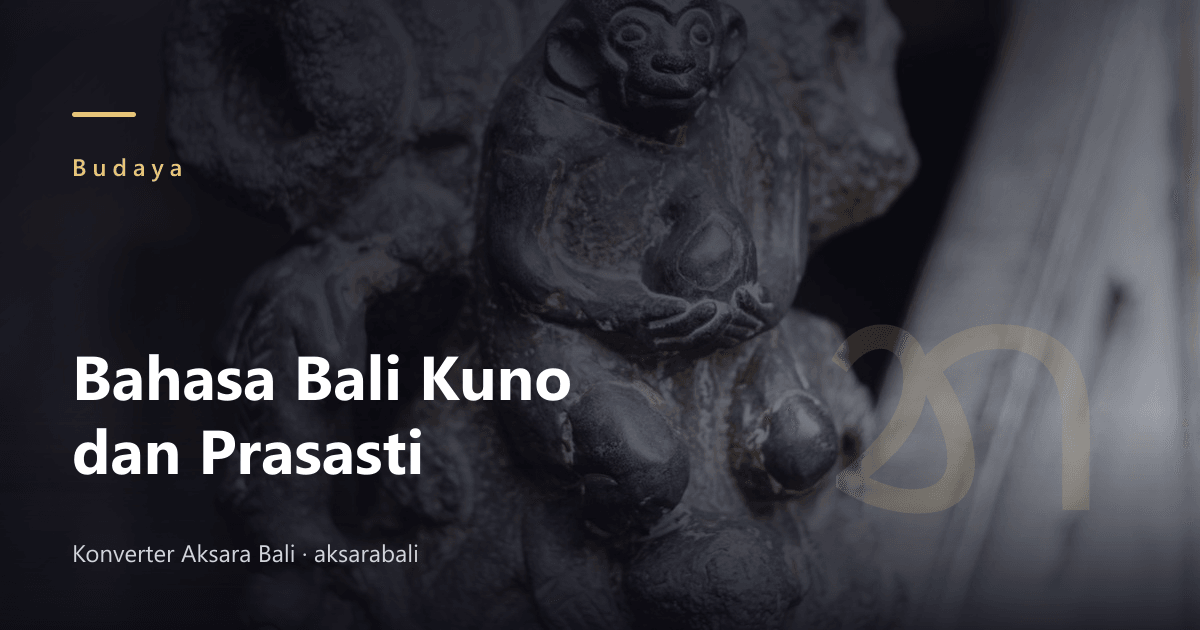
Photo by tommao wang on Unsplash
Old Balinese: The Language of Bali’s Earliest Inscriptions
- The origins of Balinese script and the Aji Saka legend
- Lontar palm-leaf manuscripts
- Kakawin, Old Javanese epic poetry in Bali
Balinese Before Balinese
The Balinese spoken today has an ancestor recorded in stone and copper: Old Balinese. It is the language Bali’s kings used, in the late 9th and the 10th century, to set down village rules, tax exemptions, and grants to hermitages.
The Earliest Inscriptions
The oldest dated inscriptions in Old Balinese come from the late 9th century. Sukawana A I, dated 804 Śaka (882 CE), is often cited as the earliest. Inscriptions like these were usually engraved on copper plates, some on stone.1
The best known is probably the Blanjong pillar in Sanur, dated 835 Śaka (913 CE). It names Sri Kesari Warmadewa and is written in two languages, Old Balinese and Sanskrit.
From the late 10th century into the 11th, Old Javanese appears more and more in Balinese inscriptions, until it replaces Old Balinese as the written language of the court.
What Do the Words Look Like?
Many Old Balinese words still feel familiar; others have changed a great deal. Some examples from the Kamus Bahasa Bali Kuno–Indonesia:2
| Old Balinese | Meaning |
|---|---|
| hayam, syap | chicken |
| wuri | behind, back |
| wka | child, son |
| hulu | head |
| hru | arrow |
| karuh | west, the western part |
| wutuh | whole, intact |
| bnang | thread |
| tmuang | year |
| danu | lake |
Notice syap: it lives on in today’s Balinese word for chicken, siap.
Old Balinese in This Dictionary
The Balinese dictionary now has its own Old Balinese tab, kept apart from everyday Balinese so the two are never mixed. Its entries come from the Kamus Bahasa Bali Kuno–Indonesia (Pusat Pembinaan dan Pengembangan Bahasa, 1985). They were read automatically from a scan of the book, and only entries that passed checking are shown, so the list is deliberately small.
Old Balinese helps with place names, inscription terms, and word origins. To speak or write today, use modern Balinese in the regular search tab.
Further Reading
Notes and sources
This article was drafted with AI assistance and is reviewed over time. Check Balinese wording with a teacher or native speaker before using it for anything official, printed, or ceremonial.