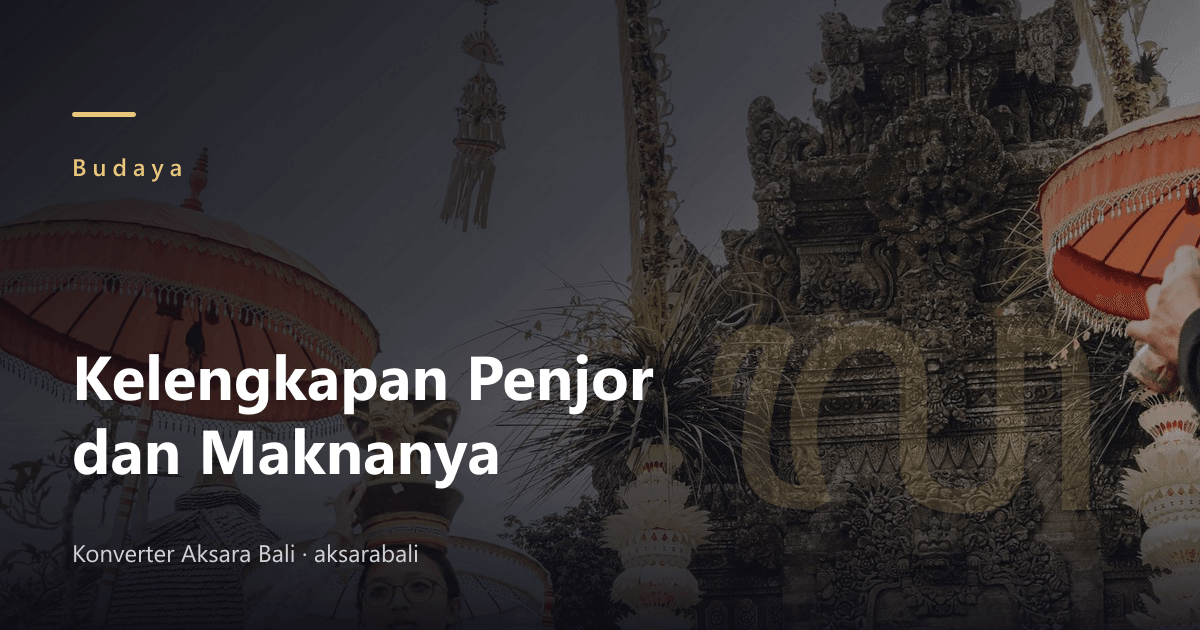
Photo by Ruben Hutabarat on Unsplash
The Parts of a Galungan Penjor and What Each One Means
- A penjor stands outside a house as part of an offering, not as a photo prop — photographing is fine, touching or moving it is not.
- Never step over or on the offerings placed at its base.
- If you want to raise one yourself, ask local residents how; the assembly follows rules rather than design taste.
A Penjor Is Not Just Decoration
In the run-up to Galungan, Balinese roads fill with penjor — tall curved bamboo poles dressed in young coconut leaf and harvest produce. To a visitor they look like festive decoration. To Balinese households, every part has its own name and meaning, and the assembly follows rules.
This page summarises the parts, along with how their names are written in Balinese script.
The Parts and Their Meanings
| Part | What it is | Symbolises |
|---|---|---|
| sampian penjor | the woven leaf ornament at the tip | Sang Hyang Parama Siwa |
| jaja gina and jaja uli | traditional cakes hung on the pole | Sang Hyang Brahma |
| kober putih kuning | a small white-and-yellow flag bearing padma and omkara | Sang Hyang Iswara |
| cili or gegantungan | a hanging figure ornament | Sang Hyang Widyadari |
| tamiang | a round shield-like ornament | a repeller of adharma |
| ubag-abig | trailing leaf decoration | Sang Hyang Rare Angon |
| tebu | a length of sugarcane | Sang Hyang Sambu |
| pala bungkah and pala gantung | tubers and fruit | Sang Hyang Wisnu |
| nyuh | coconut | Sang Hyang Rudra |
| busung and ambu | coconut and sugar-palm leaves | Sang Hyang Mahadewa |
| plawa | foliage | Sang Hyang Sangkara |
| sanggah ardha candra | the crescent-shaped offering shrine | Sang Hyang Siwa |
| banten | the offerings presented | Sang Hyang Sadha Siwa |
| lamak | the long woven hanging dressing the shrine | Sang Hyang Tribuana |
| tiing | the bamboo pole itself | Sang Hyang Mahesora |
One idea repeats through the whole structure: a penjor stands for a mountain, with the earth's produce from base to tip offered in thanks.
The Names in Balinese Script
| Latin | Balinese script |
|---|---|
| penjor | ᬧᬾᬦ᭄ᬚᭀᬭ᭄ |
| galungan | ᬕᬮᬸᬗᬦ᭄ |
| kuningan | ᬓᬸᬦᬶᬗᬦ᭄ |
| kober | ᬓᭀᬩᬾᬭ᭄ |
| cili | ᬘᬶᬮᬶ |
| gegantungan | ᬕᬾᬕᬦ᭄ᬢᬸᬗᬦ᭄ |
| tebu | ᬢᬾᬩᬸ |
| nyuh | ᬦ᭄ᬬᬸᬳ᭄ |
| busung | ᬩᬸᬲᬸᬂ |
| ambu | ᬅᬫ᭄ᬩᬸ |
| plawa | ᬧ᭄ᬮᬯ |
| sanggah | ᬲᬂᬕᬳ᭄ |
| banten | ᬩᬦ᭄ᬢᬾᬦ᭄ |
| lamak | ᬮᬫᬓ᭄ |
| jaja uli | ᬚᬚᬉᬮᬶ |
For other terms, type the Balinese word into the converter, or look it up in the Balinese dictionary.
When Penjor Go Up
Galungan penjor are usually raised on Penampahan Galungan, the day before Galungan, and stand until the festival period closes. Galungan recurs every 210 days on the Balinese calendar, and is closed by Kuningan ten days later.
Simple Etiquette for Visitors
Further Reading
The role of script in ceremony is covered in Balinese script in religious ceremony, and potent letter-and-symbol art in rerajahan. Another festival sequence is covered in the Nyepi sequence.
The breakdown here follows the infographic Eteh-eteh Penjor Galungan by Eka Setyawan, published by Komunitas Wikimedia Denpasar on Wikimedia Commons (CC BY-SA 4.0). Names and meanings vary between village communities — Balinese tradition is deliberately local, following desa, kala, patra.
This article was drafted with AI assistance and is reviewed over time. Check Balinese wording with a teacher or native speaker before using it for anything official, printed, or ceremonial.