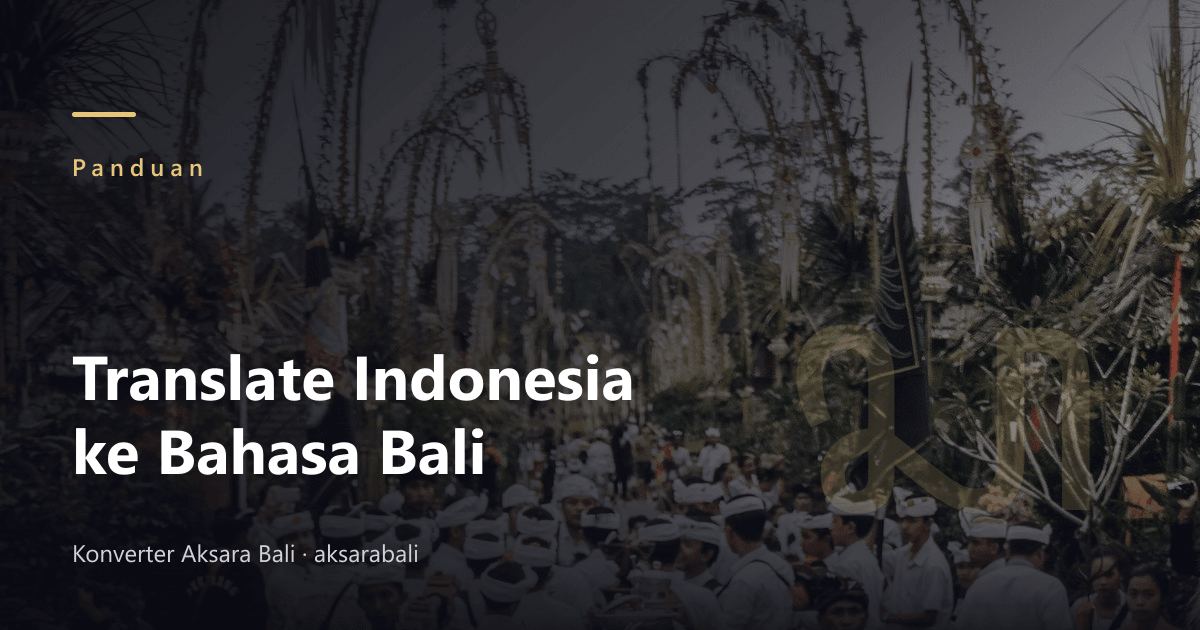
Photo by Ruben Hutabarat on Unsplash
Translating Indonesian to Balinese: What Automatic Tools Can and Cannot Do
- Compose the sentence in Balinese — using the vocabulary above, a dictionary, or a native speaker.
- Type that Balinese sentence into the Balinese script converter.
- Check the result with reverse mode or the pronunciation button, then copy it.
- Kamus Bali–Indonesia, published by Balai Bahasa and the Bali provincial culture office
- Basa Bali Wiki — an online dictionary and language community
- Balinese language teachers at schools, or lecturers in Balinese literature programmes
- Online communities — several active social media groups will happily check a sentence
- Translating word by word. Balinese sentence structure does not always mirror Indonesian.
- Mixing speech levels. Keep one level consistent within a sentence.
- Treating transliteration as translation. An Indonesian sentence in Balinese characters is still Indonesian.
- Using long sentences for tattoos or print without a native speaker's review.
Two Jobs People Keep Confusing
Someone searching for a way to turn Indonesian into Balinese may mean one of two very different things:
| What they want | The actual task | Example |
|---|---|---|
| Change the **meaning** into Balinese | translation | thank you → matur suksma |
| Change the **writing** into Balinese script | transliteration | matur suksma → ᬫᬢᬸᬭ᭄ᬲᬸᬓ᭄ᬲ᭄ᬫ |
This site's converter does the second. Feed it an Indonesian or English sentence and you get that same sentence written in Balinese characters — beautiful to look at, but still in the original language.
For genuinely Balinese wording the order is: translate first, then transliterate.
Why Balinese Translation Cannot Be Fully Automatic
Balinese has sor singgih — speech levels. The same idea is expressed with different words depending on who you are addressing: a peer, someone of higher standing, or a religious setting.
As a result, a single Indonesian word often has several Balinese equivalents, and picking the wrong one is not merely inaccurate — it can sound impolite. That is why automatic Balinese translators are rare and fragile compared with transliteration tools.
Word choice also depends on context a machine cannot see: the listener's age, social standing, and the situation itself.
A Starter Vocabulary
The words below are safe for ordinary polite conversation.
| Indonesian | Andap (everyday) | Alus / mider | Balinese script |
|---|---|---|---|
| rumah (house) | umah | puri | ᬧᬸᬭᬶ |
| air (water) | yéh | toya | ᬢᭀᬬ |
| bunga (flower) | bunga | sekar | ᬲᬾᬓᬭ᭄ |
| laut (sea) | pasih | segara | ᬲᬾᬕᬭ |
| jalan (road) | rurung | margi | ᬫᬭ᭄ᬕᬶ |
| gunung (mountain) | aga | giri | ᬕᬶᬭᬶ |
| bulan (moon) | bulan | wulan | ᬯᬸᬮᬦ᭄ |
| buku (book) | buku | pustaka | ᬧᬸᬲ᭄ᬢᬓ |
| guru (teacher) | guru | acarya | ᬅᬘᬭ᭄ᬬ |
| ibu (mother) | mémé | biang | ᬩᬶᬅᬂ |
| ayah (father) | ajung | aji | ᬅᬚᬶ |
| adik (younger sibling) | adi | rai | ᬭᬇ |
| nasi (rice) | nasi | rayunan | ᬭᬬᬸᬦᬦ᭄ |
| batu (stone) | batu | watu | ᬯᬢᬸ |
| anjing (dog) | cicing | asu | ᬅᬲᬸ |
| perempuan (woman) | luh | istri | ᬇᬲ᭄ᬢ᭄ᬭᬶ |
| laki-laki (man) | muani | lanang | ᬮᬦᬂ |
| mulut (mouth) | bungut | cangkem | ᬘᬂᬓᬾᬫ᭄ |
| cincin (ring) | bungkung | ali-ali | ᬅᬮᬶ-ᬅᬮᬶ |
| ingat (remember) | inget | éling | ᬏᬮᬶᬂ |
| banyak (many) | aken | akéh | ᬅᬓᬾᬳ᭄ |
| makan (eat) | maem | mrayunan | ᬫ᭄ᬭᬬᬸᬦᬦ᭄ |
| minum (drink) | inem | inum | ᬇᬦᬸᬫ᭄ |
| pulang (go home) | mulih | mantuk | ᬫᬦ᭄ᬢᬸᬓ᭄ |
| iya (yes) | aa | inggih | ᬇᬂᬕᬶᬳ᭄ |
| tidak (no) | aing | nénten | ᬦᬾᬦ᭄ᬢᬾᬦ᭄ |
| sudah (already) | suba | sampun | ᬲᬫ᭄ᬧᬸᬦ᭄ |
| belum (not yet) | kondén | durung | ᬤᬸᬭᬸᬂ |
| ada (there is) | ada | wénten | ᬯᬾᬦ᭄ᬢᬾᬦ᭄ |
| dari (from) | uli | saking | ᬲᬓᬶᬂ |
| di (at) | ba | ring | ᬭᬶᬂ |
| yang (which) | ané | sané | ᬲᬦᬾ |
| itu (that) | ento | punika | ᬧᬸᬦᬶᬓ |
| lagi (again) | bin | malih | ᬫᬮᬶᬳ᭄ |
| maaf (sorry) | aksama | ampura | ᬅᬫ᭄ᬧᬸᬭ |
| permisi (excuse me) | tabik | sugra | ᬲᬸᬕ᭄ᬭ |
| semua (all) | makejang | samian | ᬲᬫᬶᬅᬦ᭄ |
| sangat (very) | gati | pisan | ᬧᬶᬲᬦ᭄ |
| bagus (good) | agus | becik | ᬩᬾᬘᬶᬓ᭄ |
| hidup (life) | idup | nyeneng | ᬦ᭄ᬬᬾᬦᬾᬂ |
These columns come from the Kamus Anggah-Ungguh Kruna Bali–Indonesia, the same source behind the dictionary on this site. The andap form is everyday speech; the alus or mider form is what you use when being more respectful.
Combining the Two Steps
For example: "thank you very much" → matur suksma pisan → ᬫᬢᬸᬭ᭄ᬲᬸᬓ᭄ᬲ᭄ᬫᬧᬶᬲᬦ᭄
Where to Get Reliable Translations
For ceremonies, invitations, or formal speeches, human review is not an optional extra — it is part of the job.
Common Mistakes
Quick Questions
Can this site translate sentences into Balinese? No. It converts Latin writing into Balinese script. For meaning, use a dictionary or a native speaker, then transliterate the result here.
Does every Indonesian word have a Balinese equivalent? Not always — and the reverse holds too; some Balinese words have no compact Indonesian equivalent.
How do I write my translation in Balinese script? Type the Balinese sentence into the converter; the script appears instantly and can be copied.
Is there a ready-made list of everyday phrases? Yes — see everyday Balinese phrases and ready-to-copy script.
This article was drafted with AI assistance and is reviewed over time. Check Balinese wording with a teacher or native speaker before using it for anything official, printed, or ceremonial.